






“Quis ut Deus?” — “Who is like God?” — sounds like a question, but its meaning is a proclamation: no one is like God. No creature, power, temptation or fear can take His place.
St. Thérèse of Lisieux is remembered for simplicity, humility and her “Little Way”. Yet as a teenager she could also be remarkably determined, spontaneous and full of holy enthusiasm.
St. Francis did not call death his “Sister” because he considered it insignificant. He could speak this way because he had spent his life learning to belong to Christ and believed that death would not have the final word.
Padre Pio encouraged his spiritual children to remember their guardian angels. For him, the spiritual world was not a pious theory but a reality lived every day.


What awaits us in the coming days (4–10 October 2026)
Highlights of the week
4 October — Twenty-Seventh Sunday in Ordinary Time; in the calendar of saints, St Francis of Assisi: the parable of the wicked tenants reminds us that the vineyard of life is given by God as both gift and responsibility. In 2026 the Sunday liturgy takes precedence over the memorial of St Francis, yet his radical love of the Gospel remains a striking witness to bearing good fruit.
5 October — Monday of the Twenty-Seventh Week in Ordinary Time; St Faustina Kowalska and Blessed Francis Xavier Seelos: the parable of the Good Samaritan brings us to the heart of Christian love: we become neighbours when we stop beside the suffering of another person. St Faustina reminds us that the source of such mercy is Christ Himself.
6 October — Tuesday of the Twenty-Seventh Week in Ordinary Time; St Bruno and Blessed Marie-Rose Durocher: the Gospel of Martha and Mary reminds us of the priority of listening to God. St Bruno, founder of the Carthusians, shows the value of silence and solitude lived not as an escape from the world but as a deep encounter with Christ.
7 October — Our Lady of the Rosary: the Church turns our attention towards prayer that leads us through the mysteries of Jesus’ life with Mary. The Rosary is not mechanical repetition but a school of contemplation, gratitude and persevering trust.
8 October — Thursday of the Twenty-Seventh Week in Ordinary Time; St Pelagia the Penitent: Jesus encourages persevering prayer: “Ask, and it will be given to you.” The story of St Pelagia also reminds us that God’s mercy can transform even a life that seems completely distant from Him.
9 October — Feast of St John Henry Newman; in the parish calendar also St John Leonardi and St Denis and Companions: in the Church in England, Newman holds a special place as a witness to an honest search for truth, the development of conscience and a journey that led him into full communion with the Catholic Church.
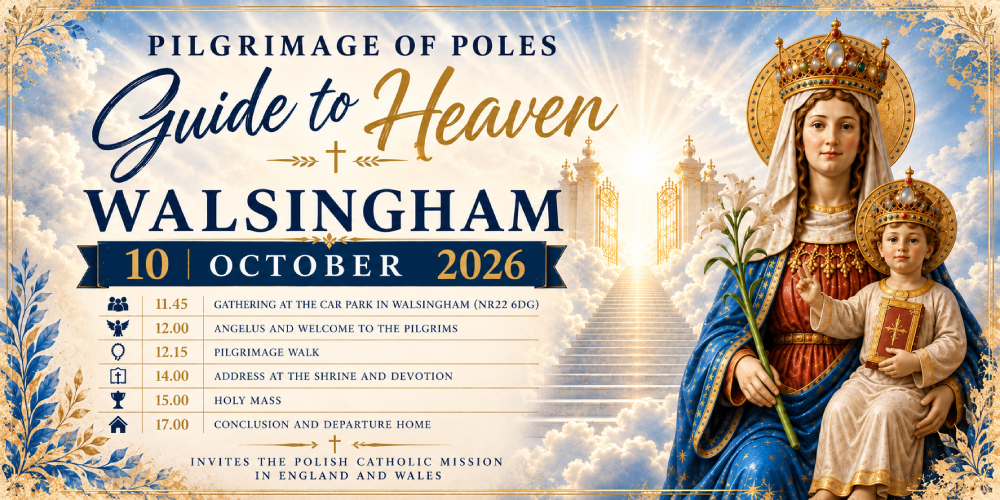
10 October — Saturday of the Twenty-Seventh Week in Ordinary Time; St Daniel Comboni: St Paul reminds us that through faith and baptism we are all one in Christ. St Daniel Comboni reveals the missionary consequences of this truth: the Gospel crosses the boundaries of culture, language and nation, while every person possesses an inalienable dignity given by God.
Catholic Calendar: 04.10–10.10.2026
Sunday, 4 October 2026 — Twenty-Seventh Sunday in Ordinary Time; St Francis of Assisi
Liturgical designation: Twenty-Seventh Sunday in Ordinary Time (green), Year A, Year II weekday cycle. The Twenty-Seventh Week in Ordinary Time and Week III of the Psalter begin. Sunday takes precedence over the memorial of St Francis of Assisi.
Readings: Is 5:1–7; Ps 80; Phil 4:6–9; Mt 21:33–43.
Meaning of the day: The prophet Isaiah presents God as the owner of a vineyard who has done everything so that it might bear good fruit. He prepared the soil, planted choice vines, built a watchtower and dug a winepress. He expected good grapes, but the vineyard produced wild fruit. The image becomes a question about the human response to grace. St Paul encourages the Philippians not to live in paralysing anxiety, but to present their needs to God in prayer and thanksgiving. The peace of God is to guard the human heart and mind. The Gospel develops the image of the vineyard in the parable of the tenants who try to seize what has only been entrusted to them. They reject the owner’s servants and eventually kill his son. Jesus reveals the tragedy of a person who wants to enjoy God’s gifts while rejecting the Giver Himself. The vineyard can represent the whole of life: time, family, vocation, talents, community and faith. All of these are gifts meant to bear fruit. The calendar of saints also remembers St Francis of Assisi. In 2026 eight hundred years have passed since his death. Francis took the Gospel radically as an actual way of life. He rejected attachment to wealth and status, served the poor and people suffering from leprosy, preached peace and saw the whole of creation as a gift from the Father. His life shows what fruit can be borne by someone who stops treating God’s gifts as private property.
Quote: “The kingdom of God will be given to a people that will produce its fruit” (cf. Mt 21:43).
Prayer: Lord, everything I possess has been received from You. Teach me to use Your gifts responsibly and to bear fruits of faith, love and peace. Through the intercession of St Francis, give me simplicity of heart and freedom from disordered attachment to material things.
Practice: Consider one particular gift you have received from God and what fruit it brings to others. Do something good today for another person or for creation, expecting nothing in return.
Saints of the day: St Francis of Assisi — founder of the Friars Minor, witness to evangelical poverty, peace and love of creation.
Monday, 5 October 2026 — Monday of the Twenty-Seventh Week in Ordinary Time; St Faustina Kowalska
Liturgical designation: In the Diocese of East Anglia: weekday of the Twenty-Seventh Week in Ordinary Time (green) or optional memorial of St Faustina Kowalska, virgin and religious (white). Week III of the Psalter. The parish calendar also recalls Blessed Francis Xavier Seelos.
Weekday readings: Gal 1:6–12; Ps 111; Lk 10:25–37.
Meaning of the day: St Paul speaks strongly about fidelity to the Gospel. The Good News cannot be freely reshaped to suit temporary human expectations. The Apostle asks whether he seeks to please people or God. The Gospel then presents one of the best-known questions addressed to Jesus: “Who is my neighbour?” Christ answers with the parable of a man attacked by robbers and of the Samaritan who stops, tends his wounds and bears the cost of helping him. Jesus reverses the original question. He does not tell us to determine who deserves to be called our neighbour. He calls us to become neighbours to those in need. St Faustina Kowalska received a particular vocation to proclaim the mystery of Divine Mercy. Her spirituality, however, does not end with an image or a prayer formula. Mercy received from God is meant to transform a person into someone merciful towards others. “Jesus, I trust in You” therefore also means refusing to pass indifferently by the person lying beside the road. The parish calendar also remembers Blessed Francis Xavier Seelos, a Redemptorist and devoted pastor.
Quote: “Go and do likewise” (Lk 10:37).
Prayer: Merciful Jesus, through the intercession of St Faustina teach me to trust Your mercy and become an instrument of it for others. Free me from indifference towards the suffering of the person placed on my path.
Practice: Pray the Chaplet of Divine Mercy today and perform one concrete work of mercy for someone you might normally overlook.
Saints of the day: St Faustina Kowalska — Apostle of Divine Mercy; Blessed Francis Xavier Seelos — Redemptorist, missionary and devoted confessor.
Tuesday, 6 October 2026 — Tuesday of the Twenty-Seventh Week in Ordinary Time; St Bruno, Priest
Liturgical designation: Weekday of the Twenty-Seventh Week in Ordinary Time (green) or optional memorial of St Bruno, priest (white). Week III of the Psalter. The parish calendar also recalls Blessed Marie-Rose Durocher.
Weekday readings: Gal 1:13–24; Ps 139; Lk 10:38–42.
Meaning of the day: St Paul recalls his past and the radical transformation brought about by God’s grace. The man who persecuted the Church was called to proclaim Christ to the nations. The Apostle shows that grace not only forgives the past but can give an entirely new direction to a person’s life. The Gospel leads us to the home of Martha and Mary. Martha is busy serving and concerned about many things. Mary sits at Jesus’ feet and listens to His word. Christ does not condemn Martha’s service, but points to the danger that even good duties can fill a person with such anxiety that no room remains for listening to God. St Bruno, founder of the Carthusians, chose a radical path of silence, prayer and solitude. He was not escaping from God present in the world, but seeking the kind of silence in which nothing could drown out His voice. For modern people surrounded by messages, phones and constant haste, his witness is particularly relevant. The parish calendar also recalls Blessed Marie-Rose Durocher, founder of the Sisters of the Holy Names of Jesus and Mary, who united prayer with concern for education and the formation of young people.
Quote: “Mary has chosen the better part” (Lk 10:42).
Prayer: Lord Jesus, amid my duties teach me to stop beside You. Through the intercession of St Bruno, give me a love of silence and prayer in which I can truly hear Your word.
Practice: Switch off your phone, music and other distractions for at least ten minutes today. Spend that time in complete silence with God.
Saints of the day: St Bruno — priest and founder of the Carthusian Order; Blessed Marie-Rose Durocher — religious sister, educator and foundress.
Wednesday, 7 October 2026 — Our Lady of the Rosary
Liturgical designation: Obligatory memorial of Our Lady of the Rosary (white), during the Twenty-Seventh Week in Ordinary Time. Week III of the Psalter.
Weekday readings: Gal 2:1–2, 7–14; Ps 117; Lk 11:1–4. Proper readings connected with the Blessed Virgin Mary may also be used.
Meaning of the day: St Paul describes his mission among the Gentiles and his meeting with the pillars of the Church in Jerusalem. Diversity of mission does not destroy the unity of the Gospel. Peter and Paul receive different tasks, yet they serve the same Christ. The Gospel brings us to the heart of prayer. The disciples ask: “Lord, teach us to pray.” Jesus gives them a prayer that begins with the Father and His name, then moves through the request for daily bread, forgiveness and protection in trial. The Memorial of Our Lady of the Rosary reminds us that the Rosary follows the same Christ-centred logic. Mary does not draw attention to herself. She leads us through the mysteries towards Jesus: His Incarnation, ministry, Passion, Resurrection and glory. Repeating the Hail Mary creates a peaceful rhythm in which the heart can remain with the events of the Gospel. October, traditionally devoted to the Rosary, is an invitation not merely to say more prayers but to look at our own lives more deeply in the light of the mysteries of Christ.
Quote: “Lord, teach us to pray” (Lk 11:1).
Prayer: Mary, Queen of the Holy Rosary, lead me through the mysteries of your Son’s life. Teach me patient, attentive prayer rooted in the Gospel. Protect our families and our parish.
Practice: Pray at least one set of mysteries today, or one decade of the Rosary for a specific intention: family, parish, peace or someone in need.
Remembrance of the day: Our Lady of the Rosary — guide in contemplating the mysteries of Christ and patroness of persevering prayer.
Thursday, 8 October 2026 — Thursday of the Twenty-Seventh Week in Ordinary Time; St Pelagia the Penitent
Liturgical designation: Weekday of the Twenty-Seventh Week in Ordinary Time (green), Week III of the Psalter. The parish calendar remembers St Pelagia the Penitent.
Weekday readings: Gal 3:1–5; Canticle Lk 1:69–75; Lk 11:5–13.
Meaning of the day: St Paul asks the Galatians whether they received the Spirit through strict observance of regulations or through faith. He warns them against attempting to build spiritual life exclusively upon their own effort. Christianity begins with God’s gift and remains a response to grace. The Gospel develops the theme of prayer. Jesus tells the story of a man who asks his friend for bread in the middle of the night and then says: “Ask and it will be given to you; search and you will find; knock and the door will be opened.” Perseverance in prayer does not mean forcing a reluctant God to act. Jesus compares God to a Father who knows how to give good gifts to His children. St Pelagia the Penitent became in Christian tradition a symbol of remarkable conversion. Her story reminds us that a person is never permanently imprisoned in the past. Grace can interrupt even a deeply established way of life and begin a completely new path. Christian penance is not contempt for oneself, but the response of someone who has discovered a love greater than their sin.
Quote: “Ask, and it will be given to you; search, and you will find” (Lk 11:9).
Prayer: Father, give me perseverance in prayer and trust that You know my true needs. Through the intercession of St Pelagia, grant the grace of conversion to all who believe it is already too late for them to return to You.
Practice: Return today to one intention for which you stopped praying because of discouragement. Entrust it to God again, adding: “Not my will, but Yours be done.”
Saints of the day: St Pelagia the Penitent — witness of conversion, penance and God’s mercy capable of transforming human life.
Friday, 9 October 2026 — Feast of St John Henry Newman, Priest and Doctor of the Church; St John Leonardi; St Denis and Companions
Liturgical designation: In England and in the Diocese of East Anglia: Feast of St John Henry Newman, priest and Doctor of the Church (white). The feast takes precedence over the weekday of the Twenty-Seventh Week in Ordinary Time. Week III of the Psalter.
Readings of the feast: 2 Tim 4:1–5; Ps 96; Jn 15:9–17.
Meaning of the day: St Paul urges Timothy to proclaim the Word “in season and out of season”, with patience, prudence and perseverance. Christian truth is not a product whose content changes according to the expectations of its audience. Yet proclaiming it requires not aggression but mature love. The Gospel reveals the source of this attitude: “Remain in my love.” Jesus calls His disciples friends and sends them out to bear lasting fruit. St John Henry Newman is one of the most important witnesses of Christianity in modern England. As an Anglican clergyman and distinguished scholar, he spent years studying the early Church, the nature of doctrine and the question of authority. His search for truth led him in 1845 to reception into the Catholic Church. Newman understood conscience not as permission to do whatever one wishes, but as an inner call to seek and accept truth honestly. His later life as a Catholic priest, Oratorian, theologian and cardinal became a witness to a journey demanding patience and courage. The parish calendar on 9 October also remembers St John Leonardi, a devoted reformer of spiritual life and founder of a religious community, and St Denis and Companions, martyrs and witnesses of missionary courage.
Quote: “Remain in my love” (Jn 15:9).
Prayer: God, through the intercession of St John Henry Newman teach me to seek truth honestly, listen to a well-formed conscience and allow truth to guide me even when it requires me to change my plans.
Practice: Consider one issue where you may be more interested in confirming your own opinion than in discovering the truth. Ask God for freedom of heart and readiness to accept what is true.
Saints of the day: St John Henry Newman — priest, cardinal, theologian and Doctor of the Church; St John Leonardi — priest and reformer; St Denis and Companions — martyrs.
Saturday, 10 October 2026 — Saturday of the Twenty-Seventh Week in Ordinary Time; St Daniel Comboni
Liturgical designation: In the Diocese of East Anglia: Saturday of the Twenty-Seventh Week in Ordinary Time (green) or one of the possible optional memorials: Saints Denis, bishop, and Companions, martyrs; St John Leonardi, priest; St Paulinus of York, bishop and missionary; or the Saturday Memorial of the Blessed Virgin Mary. Week III of the Psalter. The parish calendar also recalls St Daniel Comboni.
Weekday readings: Gal 3:22–29; Ps 105; Lk 11:27–28.
Meaning of the day: St Paul proclaims one of the most fundamental truths about Christian identity: all who have been baptised into Christ have “put on Christ.” Divisions that the world often considers most important — nationality, social status or sex — cannot become the basis for defining a person’s value before God. All who belong to Christ are heirs of the promise. The Gospel contains a short dialogue. A woman in the crowd blesses the mother of Jesus, and Christ responds that even more blessed are those who hear the Word of God and keep it. He does not diminish Mary — she is precisely the most perfect example of a person who hears the Word and fulfils it. The parish calendar recalls on this day St Daniel Comboni, bishop, missionary and founder of missionary congregations. Comboni devoted his life to evangelisation and service among the peoples of Africa, opposed slavery and emphasised the need to form local Christian communities. His well-known vision of “saving Africa through Africa” indicated that mission cannot consist in treating other peoples as passive recipients. Every person receives dignity, vocation and responsibility from God. His life strongly echoes Paul’s teaching about the unity of all in Christ.
Quote: “For in Christ Jesus you are all children of God through faith” (cf. Gal 3:26).
Prayer: Lord Jesus, teach me to see every human being as a person created and loved by God. Through the intercession of St Daniel Comboni, strengthen missionaries and all local Churches, especially in Africa.
Practice: Pray for missionaries and Christians living in another country or culture. Consider also whether you judge someone mainly by nationality, origin, profession or social position.
Saints of the day: St Daniel Comboni — bishop, missionary and Apostle of Africa; St Denis and Companions — martyrs; St John Leonardi — priest and reformer; St Paulinus of York — bishop and missionary.
The period from 4 to 10 October 2026 leads from the image of the vineyard entrusted to humanity towards the question of the fruits of our lives. St Francis of Assisi shows that the Gospel bears fruit when it ceases to be merely a beautiful idea and becomes an actual way of living. On the following day St Faustina directs our attention towards Divine Mercy, which we first receive and are then called to carry to others like the Good Samaritan.
St Bruno leads us into silence and reminds us that even the most necessary activity must grow from listening to Christ. Our Lady of the Rosary teaches us to contemplate the Gospel with Mary. St Pelagia reminds us that no past removes the possibility of conversion and that persevering prayer opens the heart to God’s action.
The Feast of St John Henry Newman has particular significance for the Church in England. His journey shows that faith is not afraid of honest questions and that a well-formed conscience leads towards truth rather than towards comfortable confirmation of our own desires. The week concludes with St Daniel Comboni, whose missionary zeal reminds us of the universality of the Church and the equal dignity of all the baptised.
It is therefore a week leading from responsibility for the entrusted vineyard to missionary unity in Christ: from possession to gratitude, from indifference to mercy, from noise to silence, from distraction to the Rosary, from sin to conversion, from opinion to truth, and from being closed within our own world to responsibility for the whole Church.
Roman Martyrology and the remembrance of the saints (4–10 October 2026)
The days from 4 to 10 October lead us from the evangelical simplicity of St Francis through Divine Mercy, Carthusian silence, the Rosary and conversion towards the search for truth with St John Henry Newman and the missionary zeal of St Daniel Comboni.
4 October
Twenty-Seventh Sunday in Ordinary Time. The memorial of St Francis of Assisi gives way to the Sunday liturgy in 2026. A day of prayer for peace, simplicity of life, care for the poor, responsibility for creation and the renewal of the Church through authentic Gospel living.
5 October
Monday of the Twenty-Seventh Week in Ordinary Time or optional memorial of St Faustina Kowalska. The parish calendar also recalls Blessed Francis Xavier Seelos. A day of prayer for trust in Divine Mercy, sinners, the dying, confessors and people in need of practical help.
6 October
Tuesday of the Twenty-Seventh Week in Ordinary Time or optional memorial of St Bruno. The parish calendar also remembers Blessed Marie-Rose Durocher. A day of prayer for contemplative religious, Carthusians, teachers, educators and all those seeking the silence needed to hear God.
7 October
Obligatory memorial of Our Lady of the Rosary. A day of prayer for families, parishes, peace in the world, those distant from the Church and the renewal of the practice of the Rosary.
8 October
Thursday of the Twenty-Seventh Week in Ordinary Time; parish remembrance of St Pelagia the Penitent. A day of prayer for conversion, perseverance in prayer, freedom from past sins and hope for those convinced that they can no longer change their lives.
9 October
In England: Feast of St John Henry Newman, priest and Doctor of the Church. A day of prayer for seekers of truth, students, academics, theologians, converts and Christian unity. The parish calendar also remembers St John Leonardi and St Denis and Companions.
10 October
Saturday of the Twenty-Seventh Week in Ordinary Time, with the possibility of celebrating the memorials of St Denis and Companions, St John Leonardi, St Paulinus of York or the Saturday Memorial of the Blessed Virgin Mary. The parish calendar also recalls St Daniel Comboni. A day of prayer for missionaries, the Church in Africa and all peoples awaiting the witness of the Gospel.
Prayer for 04.10–10.10.2026
Lord Jesus,
lead me through this week
from gift to responsibility,
from words to fruit,
from anxiety to peace,
and from my own plans
to Your Gospel.
Through St Francis of Assisi,
free me
from disordered attachment
to possessions,
money,
comfort
and human approval.
Teach me to see
the whole of creation
as a gift from Your Father.
Through St Faustina,
lead me
to the source of Your Mercy.
When I fall,
give me courage to return.
When I encounter
another person’s suffering,
do not allow me
to pass by indifferently.
Jesus, I trust in You.
Through St Bruno,
give me the silence
my heart needs.
Amid messages,
phones,
haste
and responsibilities,
teach me to sit
at Your feet
and simply listen.
Our Lady of the Rosary,
lead me through the mysteries
of your Son’s life.
Teach me to look
at my own life
in the light of His birth,
teaching,
Cross,
Resurrection
and glory.
Through St Pelagia,
give hope to those
who think
their past
is too heavy
to begin again.
Remind us
that Your mercy
is greater than sin.
Through St John Henry Newman,
give me courage
to seek truth honestly.
Do not allow me
to call my own comfort
or desires
“conscience”.
Teach me to listen,
discern
and follow truth,
even when it leads me
along a road
I had not planned.
Through St John Leonardi,
renew Your Church.
Through St Denis
and his Companions,
give courage to missionaries
and all witnesses of the Gospel.
Through St Daniel Comboni,
open my heart
to the whole Church.
Free me
from judging another person
according to nationality,
skin colour,
language,
background
or social position.
Remind me
that in Christ
we are all one.
May the days
from 4 to 10 October
lead me
from possession to gratitude,
from indifference to mercy,
from noise to silence,
from distraction to prayer,
from sin to conversion,
from opinion to truth,
and from being closed within myself
to a heart open
to Your whole Church.
Amen.
- 5 Saints to Pray to If You Are Feeling Lonely
- 6 Distractions That May Be Keeping You From God
- Whose Blood Miraculously Liquefies in Naples?
- Why Did Padre Pio Remember His Childhood So Fondly?
- 4 Saints to Help You With Holy Hospitality
- Catholic calendar 27 September – 3 October 2026
- Catholic Calendar: 20.10–26.10.2026
- Catholic Calendar: 13.10–19.10.2026
- Catholic Calendar: 06.09–12.09.2026
- Catholic Calendar: 30.08–05.09.2026