

In the liturgical calendar of the Church, there are many special and beautiful celebrations. There are solemn feasts filled with joy, moments of prayerful silence, and days that are deeply woven into the life of Christian families. Yet among them all, one feast stands at the very center. That feast is Easter — the most important Christian celebration, the heart of faith, the source of hope, and the deepest meaning of the Church’s proclamation.
For many people, Christmas seems the most moving feast of all. That is easy to understand. The birth of Jesus speaks to the emotions and creates an atmosphere of warmth, closeness, and family gathering. Easter, however, takes us deeper. It does not stop at emotion. It places the human person before the greatest questions of all: the meaning of suffering, the reality of death, the possibility of forgiveness, the promise of eternal life, and whether God truly watches over human history.
That is why Easter is the most important feast. It does not simply tell us about the beginning of Jesus’ earthly life; it reveals the meaning of His entire mission. In His Passion, death, and resurrection, the fullness of God’s love for humanity is made known. Here the greatest drama of human history is answered — the struggle between sin and grace, despair and hope, death and life.
Easter Is Not Only a Memory of the Past
Christianity is not based merely on preserving the memory of great historical events. When the Church celebrates Easter, it is not only recalling what once happened in Jerusalem. The liturgy leads us into something far greater: a living encounter with the risen Christ.
This means that Easter is not just an anniversary. It is a reality that continues. Jesus, who died and rose again, does not belong only to the past. He lives. He is present among His people. He acts through the sacraments, speaks through the Word of God, strengthens the faithful with grace, lifts up those who have fallen, and gives light to those passing through darkness.
Therefore, Christians do not celebrate Easter as spectators of ancient events, but as participants in Christ’s victory. This feast reminds us that faith is not merely a system of values, a collection of rules, or a religious tradition passed down from generation to generation. Christian faith is the response to an encounter with Jesus who lives.
The Cross and the Resurrection — One Great Mystery of Love
Easter cannot be understood without Good Friday. Nor can Good Friday be properly understood without the dawn of the Resurrection. These two realities are inseparably linked.
On the cross, Christ reveals a love that does not retreat before sacrifice. He does not flee from suffering, He does not answer violence with violence, and He does not choose His own safety at the expense of truth. He gives Himself completely. He takes upon Himself the burden of human sin, loneliness, fear, and pain. The cross shows that God is not distant from human suffering. He enters directly into it.
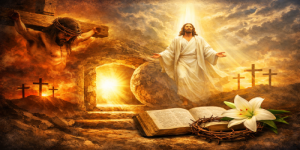
Yet Christianity does not end at the cross. If the tomb of Jesus had remained closed, the Gospel would be the story of a moving defeat. Christ would be remembered as a great teacher, a righteous man, and a prophet of love — but not as the Savior who conquered death. The Resurrection changes everything. It reveals that Jesus’ sacrifice was accepted by the Father, that death does not have the final word, and that love is stronger than sin.
Without the Resurrection, Christian Faith Would Lose Its Foundation
From the earliest centuries, the Church proclaimed one central truth: Christ is risen. This was never a secondary issue or a mere symbol. It was the foundation of everything. The Apostles did not give their lives for a beautiful idea, but for the testimony that they had truly encountered the risen Lord.
It is the Resurrection that gives meaning to the whole Gospel. Because of it, the words of Jesus are not merely moral wisdom, but the word of God who has power over life and death. Because of it, the cross is not a sign of failure, but a throne of victory. Because of it, the Church is not just a community of memory, but the community of the living Lord.
Easter Answers Humanity’s Deepest Fear
Every human being, sooner or later, must confront the question of death. Even if it is pushed aside in daily life, there comes a moment of illness, grief, personal suffering, or loneliness when the question becomes painfully clear. At such times, shallow comfort is no longer enough. The human heart needs a hope greater than circumstances.
Easter offers precisely that hope. Not cheap optimism. Not an escape from reality. Not a simple promise of a painless life. It offers something far deeper: the certainty that even in the darkest hour, God can open the way to life.
The Resurrection of Christ means that death has been conquered from within. Jesus did not avoid the human condition — He entered into it completely. He experienced abandonment, suffering, and death, so that no human night would ever again be without His presence. For that reason, Christians can face grief, suffering, and fear differently — not without tears, but with hope in the midst of tears.
Easter Is the Feast of New Life Already Here on Earth
When people speak about resurrection, they often think only about life after death. It is true that Easter opens before us the promise of eternal life. But its message is not only about the future. It begins here and now.
The risen Christ comes to transform the human heart. Where there is sin, forgiveness can be born. Where there has been despair, peace can arise. Where relationships have been broken, reconciliation can begin. Where a person feels spiritually dead, new life in grace can awaken.
Easter therefore says to each one of us: you are not condemned to your failures. You are not trapped forever in your own history. You are not a prisoner of your wounds. In Christ, new life is always possible.
This Feast Shapes the Identity of the Whole Church
The Church lives from the Paschal Mystery. Every Eucharist is rooted in the sacrifice and Resurrection of Christ. Every baptism is a participation in His death and a rebirth into new life. Every confession is a paschal passage from the death of sin into the freedom of grace.
That is why Easter is not simply one element among many in the life of the Church. It is the center. From it flows the mission to proclaim the Gospel. From it comes the courage of martyrs, the fidelity of saints, the patience of those who carry the cross of daily life, and the joy of those who know how to thank God even in hardship.
Easter Teaches True Hope
The modern world often speaks of hope, but usually in a shallow sense. Christian hope is something much deeper. It is rooted not in human capability, but in the faithfulness of God.
Easter reminds us that even when everything seems lost, God is at work. Good Friday appeared to the disciples as a moment of complete collapse. What seemed destined for triumph ended at the cross. And yet it was precisely there that the victory no one expected had already begun.
This is an important lesson for us as well. In personal life, family life, and parish life, there are moments when it seems that good is losing, truth has fallen silent, and prayer bears no fruit. Easter speaks into those moments and tells us that God can bring life out of what looks like an ending.
What Does Easter Say to Believers Today?
First of all, it says that we are not alone. Christ lives and is present. It says that sin does not have to be our final destiny. It says that forgiveness is possible. It says that suffering is not meaningless when it is lived with Jesus. It says that death does not close everything. It says that the love of God is stronger than our failures.
But Easter also makes a demand. If Christ truly lives, then faith cannot be only an addition to life. It cannot remain a tradition observed only on special occasions. Easter calls us to conversion, to renewed prayer, to deeper trust, and to more courageous witness.
EternalFlames.co.uk
Looking for inspiring content on faith, culture, music, and the modern world? Visit Eternal Flames — a place filled with articles, reflection, and meaningful reading. Visit EternalFlames.co.uk