

Can a Christian Write About Darkness?
Faith, literature and hope in the work of P.D. Thompson — a writer who portrays fear and spiritual conflict not to glorify evil, but to remind readers of the need for grace and redemption.
Can a story portraying fear, suffering, guilt and spiritual conflict lead a person towards God? Should a Christian writer avoid everything dark, or may they enter the territory of human anxiety in order to show that evil does not have the final word?
These questions become especially important when a Christian artist uses the language of horror, Gothic fiction or psychological suspense. Some consider such forms incompatible with faith. Others see in them an opportunity to confront honestly the reality of sin, suffering and human weakness.
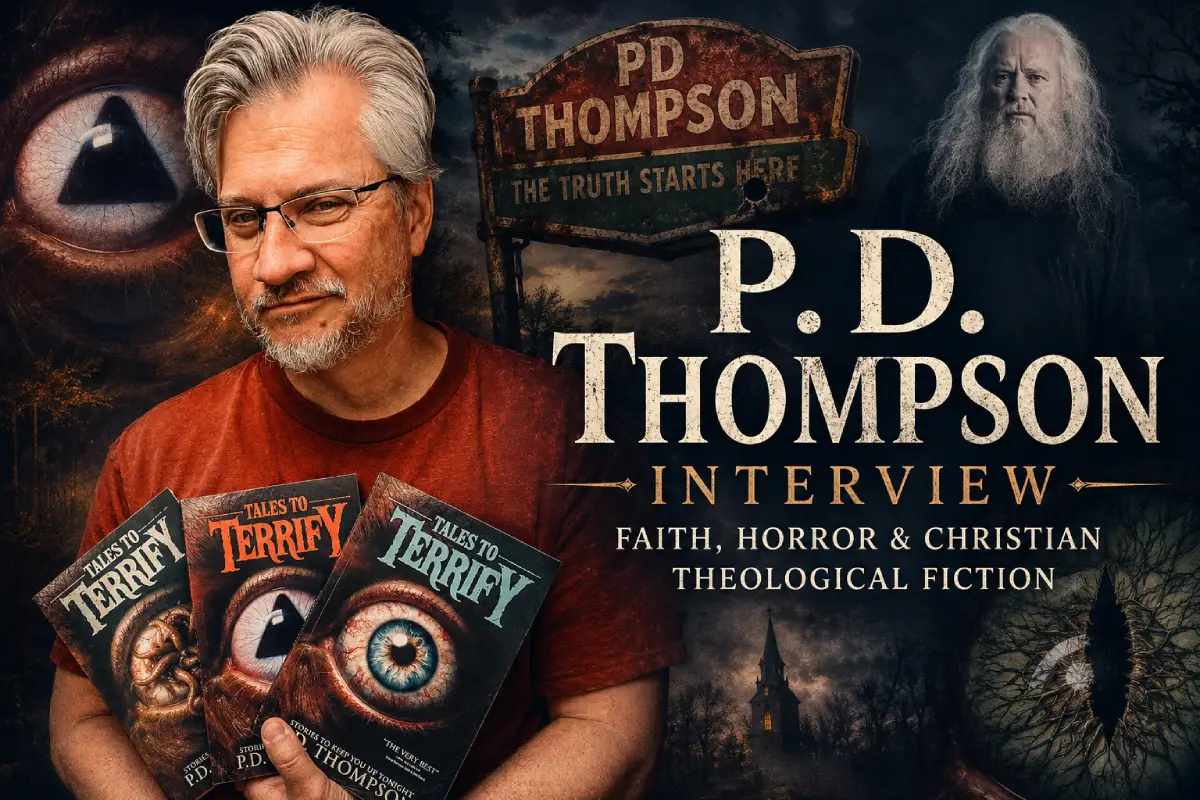
One writer who explores these themes is P.D. Thompson, also known as Philip Dale Thompson — an American author from Kentucky and the vocalist of the Christian rock band Bride.
In an extensive interview with Eternal Flames, he discussed his understanding of Christian theological fiction, the relationship between theology and imagination, and the boundary between honestly depicting darkness and turning it into spectacle.
Christian art does not need to pretend that evil, suffering and fear do not exist. It should, however, help people recognise their true nature and show that none of them is stronger than God.
From music to storytelling
For decades, Dale Thompson expressed his faith primarily through music. As the vocalist of Bride, he sang about spiritual warfare, human weakness, faith, salvation and the need for a personal response to the Gospel.
Literature, however, did not suddenly appear in his life. As he recalls in the interview, stories had accompanied him since childhood. He says he wrote his first story at around the age of five. Later, his imagination found expression in song lyrics, poetry and short scenes that he recorded in writing.
In time, he discovered that some themes could not be fully explored within a song lasting only a few minutes. A musical composition can evoke strong emotions and direct the listener towards a particular truth, but a novel allows the writer to remain with a question for longer, enter more deeply into the motivations of characters and show the consequences of their choices.
P.D. Thompson therefore does not regard literature as a rejection of his earlier artistic calling. For him, it is another language through which he can explore faith, fear, sin and redemption in a more developed form.
“A novel gives these realities room to breathe.”
P.D. Thompson
What is Christian theological fiction?
P.D. Thompson describes part of his work as Christian theological fiction. He does not understand this merely as an attractive genre label or a marketing category.
In his view, theology should not be an addition attached to a completed story. It should form the foundation of the fictional world. Truths concerning sin, judgement, God’s holiness, mercy, redemption and God’s final victory influence the characters, their decisions and the consequences of their actions.
The purpose is not to create “a sermon disguised as a novel”. Characters should not become vehicles for lengthy doctrinal lectures. Truth should emerge through events, moral choices, inner conflicts and the effects of human behaviour.
The author compares theology to the atmosphere breathed by the characters and to a force pulling on their decisions. Sin is no longer merely a theological term, but a shadow present in human life. Grace is not an abstract definition, but light reaching into a wounded place.
A good Christian story does not need to give the reader every answer directly. It may create a space in which a person begins to recognise the weight of their own choices, the need for forgiveness and the beauty of redemption.
Can theology exist in a story without becoming preachy?
One of the greatest challenges facing a Christian artist is presenting faith naturally. A story can lose its power when its characters become little more than instruments used to communicate the author’s arguments.
P.D. Thompson believes theology should shape the reality of the story, rather than appearing only in dialogue. Truth is then revealed through the way a person responds to suffering, temptation, guilt, forgiveness, the possibility of conversion or an encounter with the consequences of their own actions.
This approach reminds us that faith in everyday life is not limited to speaking correct sentences. It is expressed through choices, relationships, attitudes towards others and the way difficulties are faced.
“Redemption becomes light breaking through the trees.”
P.D. Thompson
Why does darkness appear in a Christian story?
Not every work that portrays evil is itself evil. Likewise, not every work that speaks about faith necessarily leads the reader towards what is good. Both the manner in which a subject is presented and the purpose it serves are important.
Violence may be portrayed in order to shock, fascinate or entertain. It may also be shown in order to reveal its tragic consequences, the suffering of its victims and the spiritual devastation it leaves behind.
P.D. Thompson draws a clear line between honestly portraying evil and turning it into spectacle. He is not interested in violence for its own sake, cruelty as entertainment or graphic bloodshed designed simply to provoke.
He is far more interested in fear arising from conscience, memory, guilt and the things people attempt to hide from themselves. Darkness in his stories is meant to expose the truth about evil, not encourage fascination with it.
“I do not write about darkness in order to glorify it — I write to expose it.”
P.D. Thompson
A boundary a Christian artist should not cross
Discernment is necessary for both the artist and the audience. Not every form of depicting evil is morally neutral. Art can lead to reflection, but it can also desensitise people to cruelty, turn suffering into an object or encourage an unhealthy fascination.
A Christian artist should therefore ask not only whether a particular subject may be shown, but also how it is shown and where it leads the audience.
Is the suffering of a character treated with the seriousness it deserves? Is evil shown as something that destroys the human person? Is the audience left only with despair? Does the story help name sin and its consequences, or does it make evil appear attractive?
Fear as the voice of conscience
Fear can affect a person in different ways. It can paralyse, remove hope and distort the image of God. It can also strip away appearances, remind us of the fragility of life and force us to ask questions we have previously avoided.
What happens to a person after death? Do good and evil have objective meaning? Do our choices carry consequences? Can guilt be hidden from one’s own conscience? Does the human person need a salvation that cannot be achieved through personal effort alone?
P.D. Thompson believes that a story using fear can compel the reader to confront what they truly believe about God, their own life and the unseen reality.
This does not mean that fear should be the primary method of proclaiming the Gospel. Christianity is not based on emotionally frightening people. There are, however, truths concerning sin, death, judgement and responsibility that cannot honestly be removed from the Christian vision of reality.
Art can sometimes name the fear a person already carries within. Its purpose should not be to leave them terrified, but to lead them towards truth, responsibility, mercy and hope.
Scripture does not hide difficult images
The Bible is not a book without dramatic events. It speaks of sin, violence, betrayal, war, persecution, death, judgement and spiritual conflict. It also contains plagues, prophetic visions, demonic activity and apocalyptic images that may cause unease.
These passages are not intended as entertainment or as a source of fascination with evil. They show the seriousness of sin, the truth about the human condition and the need for divine intervention.
Scripture does not leave the human person in a world without meaning. The history of salvation leads to Christ, who through His death and Resurrection conquers sin and death.
A Christian story may therefore lead the audience through a valley of fear, but it should not proclaim that despair is the final truth about reality.
“The light shines in the darkness, and the darkness has not overcome it.”
John 1:5
Why is Thompson interested in Southern Gothic?
The style known as Southern Gothic occupies an important place in the work of P.D. Thompson. It is associated with small communities, family secrets, inherited guilt, religious hypocrisy, broken relationships and the consequences of events that were meant to remain forgotten.
The author grew up in rural Kentucky. He knows the landscape of small churches, fields, gravel roads, forests, abandoned buildings and places where apparent peace may conceal painful stories.
This environment becomes for him an image of the human soul. Outwardly, a person may appear calm and ordered while inwardly carrying hidden wounds, guilt, anger or fear.
Southern Gothic also reminds us that sin is not merely a private matter. Its consequences may pass through families and entire communities. Wounds left unhealed affect future relationships and generations.
Christian hope does not consist in denying that a person or community has been wounded. It rests on the belief that grace can enter precisely where the damage appears deepest.
Religious behaviour does not always mean living faith
One difficult theme found in Gothic literature is religious hypocrisy. A person may use the language of faith while living in a way that contradicts the Gospel.
Someone may speak about God while exploiting others. They may publicly defend morality while privately hiding abuse. They may use religion to build their own position, create fear or justify a lack of mercy.
Showing such attitudes is not necessarily an attack on the Church or faith. It can be a call to examine one’s conscience. Jesus Himself strongly warned against hypocrisy, pride and religious practice limited to outward gestures.
“These people honour Me with their lips, but their hearts are far from Me.”
Matthew 15:8
Literature can therefore remind us that genuine faith should lead to conversion of heart, love of neighbour, humility, responsibility and truth.
Can horror become a form of Christian ministry?
P.D. Thompson accepts that responsibly written horror may serve a form of Christian ministry. He also stresses that not every story needs to become a sermon or a tool of direct evangelisation.
A story may serve what is good when it helps the audience recognise the true enemy: not a fictional monster, but fear, sin, pride, guilt or despair separating a person from hope.
It may also remind readers that God is not surprised by human evil. He does not lose control of creation, and His victory does not depend on the weakness of the enemy.
Such literature should not crush the reader or convince them that the world is without meaning. It should instead leave them more aware of the seriousness of their life and more convinced that God remains present even in the deepest night.
The most important criterion is not simply the use of dark imagery, but whether the story leads towards nihilism and despair or helps reveal human responsibility and the victory of grace.
Christianity rejects nihilism
In some horror literature, the world is portrayed as indifferent, chaotic or hostile towards humanity. Human life has no lasting meaning, and evil is presented as a force that cannot ultimately be overcome.
The Christian vision of reality is different. Creation is not an accident. The human person is not a meaningless fragment of an indifferent universe. Each person has been created by a personal God who knows them and calls them by name.
The world has been wounded by sin, but it has not been abandoned. God entered human history by taking on human nature. Christ experienced suffering and death, and then rose from the dead.
A Christian author may therefore use the image of night while remembering that night is not the final state of creation.
“Darkness is never final.”
P.D. Thompson
Evil should be exposed, but we must not feed upon it
The audience also bears responsibility for the content it chooses. A person should observe what effect a particular book, film, piece of music or game has on their thoughts, emotions, relationships and spiritual life.
What may be a serious reflection on conscience for one person may cause unnecessary fear, intrusive images or unhealthy fascination in another. Human sensitivity differs and should be respected.
Christian freedom does not remove the need for discernment. Not everything a person is permitted to watch or read will be beneficial for them.
“I have the right to do anything — but not everything is beneficial.”
1 Corinthians 6:12
It is therefore worth asking:
- Does this story help me understand the truth about the human person more deeply?
- Does its depiction of evil lead to reflection or only to fascination?
- Does the work respect the dignity of the suffering person?
- Does it increase my fear, aggression or spiritual unrest?
- Can I maintain a healthy distance between fiction and reality?
- Does this content weaken my prayer and relationships, or help me think more deeply?
Not every kind of literature is for everyone
No one is obliged to read horror fiction or explore the work of P.D. Thompson. A person who reacts badly to dark imagery or experiences severe anxiety may prudently avoid such material.
A person’s faith should not be judged solely by their artistic preferences. One individual may discover spiritual depth in quiet poetry, another in a historical novel, and another in a story showing the dramatic consequences of sin.
It is important not to confuse personal sensitivity with a rule binding everyone. At the same time, the warnings of one’s own conscience should not be ignored.
Art should leave room for hope
Christian hope is not a naïve belief that everything in life will quickly and easily improve. It does not deny suffering or promise that every earthly story will end according to our expectations.
Its foundation is the person of Jesus Christ. He passed through suffering and death. He entered the deepest darkness of human experience, but death could not hold Him.
Even a story dealing with guilt, spiritual confusion or fear may therefore retain a Christian perspective if it does not present evil as equal to God.
Evil can wound and destroy, but it is not all-powerful. Sin has tragic consequences, but forgiveness exists. A person may become lost, but they may also be found.
Christianity does not say that night does not exist. It proclaims that night does not last forever and that the light of Christ is stronger than every darkness.
The deepest fear of the human person
Literary monsters are products of imagination. Far more real are fears connected with loneliness, rejection, the loss of loved ones, illness, death, guilt and the question of life’s meaning.
People may attempt to silence these questions through work, entertainment, shopping or constant activity in digital media. They do not disappear merely because we stop speaking about them.
A valuable story can create a safe space in which the audience encounters them indirectly. A reader may recognise part of their own experience in the life of a character and see where avoidance of truth eventually leads.
Not every book will bring spiritual transformation. Literature does not replace prayer, the sacraments, conversation with someone close or professional help when it is needed. It may, however, become the beginning of reflection.
Conscience, memory and hidden guilt
P.D. Thompson stresses that he is less interested in spectacular violence than in the psychological unease connected with conscience and memory.
A person may hide guilt for years, rationalise the harm they have caused or pretend that the past no longer matters. Conscience, however, does not always allow a person to forget completely.
Christianity does not lead people into endless self-accusation. It leads towards admitting the truth, sorrow for sin, repairing harm where possible and accepting God’s forgiveness.
“If we confess our sins, He is faithful and just and will forgive us our sins.”
See 1 John 1:9
A story showing the consequences of hidden guilt may therefore remind us that freedom begins with truth. A person is not healed by pretending nothing happened, but by encountering the mercy of God.
Can a person find God through a story?
God may use many paths to touch the human heart. Sometimes it will be a passage of Scripture, a homily, a sacrament, a meeting with another person or a personal experience. At other times, an important question may begin with a book, a film, a painting or a piece of music.
This does not mean every work of culture is a form of revelation. God’s revelation transmitted in Scripture and Tradition has a unique character. Art may, however, help a person see their life from another perspective.
It may name an experience that we were previously unable to describe. It may expose a mechanism of evil against which we need to protect ourselves. It may also awaken a longing for goodness, truth, forgiveness and meaning.
Art does not replace the Gospel. It may, however, awaken a question to which Christ gives the fullest answer.
How should difficult art be discussed in the Church?
Discussion of culture within Christian communities should not be reduced to a simple division between works that are “safe” and those that are “forbidden”. Discernment, knowledge of context and an honest evaluation of the content are necessary.
A work should not be condemned solely on the basis of its cover, genre label or a single image taken out of context. At the same time, one should not assume that everything created by someone professing faith is automatically valuable.
A mature audience should ask about the vision of humanity, God, good, evil, suffering and freedom present in the entire work.
This kind of conversation may be particularly important when speaking with young people. A prohibition without explanation often fails to encourage maturity. It is better to help them recognise the intention of the artist, the artistic methods being used, the consequences of the choices portrayed and the influence of content on their own lives.
What can we learn from P.D. Thompson’s reflections?
One does not need to share all of the author’s artistic choices or take an interest in horror fiction in order to recognise several important questions arising from his statements.
- Can we speak about evil without becoming fascinated by it?
- Is our faith present in our daily choices, or only in the words we speak?
- Can we face the truth about our own guilt and accept forgiveness?
- Do we remember that the sin of one person may wound an entire community?
- Does the culture we choose help us grow, or weaken our conscience?
- Do we believe that God’s grace can enter even the most deeply wounded places?
Darkness does not receive the final word
The most important idea emerging from the conversation with P.D. Thompson is the conviction that darkness may be portrayed, but it should never be presented as the final truth about the world.
A Christian artist may speak about sin, fear, death and spiritual conflict if this is done responsibly. The artist should remember, however, that their task is not to feed the audience with despair.
The Christian vision of the human person does not end with the Fall. It points towards the possibility of conversion, forgiveness and renewal.
The Cross reveals the weight of sin. The Resurrection reveals that the love of God is stronger than evil and death.
A genuinely Christian story may enter the night, but not in order to remain there. It enters to search for light and to remind us that God remains present even when a person cannot yet see Him.
Light shines even in wounded places
Every person carries a story containing both brighter and darker chapters. Some experiences are easy to speak about, while others remain hidden.
We may carry fear, shame, regret, guilt or wounds caused by another person. Christ does not expect us to put our entire story in order by ourselves before coming to Him.
He comes precisely into wounded places. He does not glorify darkness, but disperses it. He does not deny the truth about sin, but opens the way to forgiveness. He does not promise a life without suffering, but assures us that we will not pass through it alone.
“The Lord is my light and my salvation — whom shall I fear?”
Psalm 27:1
A prayer for light in times of fear
Lord Jesus Christ, You are the light of the world. Enter the places in my life that remain hidden beneath the burden of fear, guilt and painful memories. Teach me to distinguish truth from appearance, goodness from fascination with evil, and healthy reflection from anxiety that removes hope. Give me the courage to face the truth about myself and receive Your mercy. Do not allow darkness to hide Your presence from me. Lead me towards freedom, reconciliation and peace. Amen.
A short prayer before engaging with culture
Holy Spirit, give me wisdom and discernment. Help me choose what leads towards goodness, truth and spiritual growth. Protect my heart from content that weakens my conscience, creates unhealthy fascination or draws me away from God. Teach me to recognise the light of Christ even within the difficult questions raised by human culture. Amen.
Source and context of this article
This article was prepared on the basis of an extensive interview published by Eternal Flames with P.D. Thompson — an American writer and vocalist of the Christian rock band Bride.
Full interview:
P.D. Thompson: When Christian Theology Meets Southern Gothic and Horror
The interview was published by Eternal Flames on 27 July 2026. The statements quoted in this article express P.D. Thompson’s views concerning his own creative work.
FAQ
Who is P.D. Thompson?
P.D. Thompson, or Philip Dale Thompson, is an American writer from Kentucky. He is also known as Dale Thompson, vocalist of the Christian rock band Bride.
What is Christian theological fiction?
According to P.D. Thompson, it is a form of storytelling in which theology is not merely added to the plot. Truths concerning sin, judgement, God’s holiness, mercy and redemption shape the fictional world, the characters and the consequences of their choices.
Can a Christian read horror fiction?
There is no single answer appropriate for everyone. Discernment, personal sensitivity and the message of the particular work should all be considered. The content should not lead towards fascination with evil, weakening of conscience or lasting anxiety.
Does portraying evil mean promoting it?
Not always. A work may show evil in order to reveal its consequences, warn against it or encourage reflection. Evil is promoted when it is presented as attractive, separated from responsibility or used only as entertainment.
Where is the boundary when depicting violence?
The boundary may be crossed when human suffering becomes spectacle, violence exists only to stimulate the audience and evil is separated from moral consequences. P.D. Thompson emphasises that he is not interested in cruelty as entertainment.
Why does Christian literature sometimes speak about fear?
Fear may encourage reflection on death, conscience, responsibility, judgement and the need for grace. It should not, however, be used to manipulate the audience or leave them without hope.
Does the Bible contain dark imagery?
Yes. Scripture presents sin, violence, death, judgement, demonic activity, plagues and apocalyptic visions. These images do not serve fascination with evil, but reveal its seriousness and lead towards the history of salvation.
What is Southern Gothic?
Southern Gothic is a literary tradition associated with small communities, family secrets, religious hypocrisy, inherited guilt, broken relationships and the consequences of the past. P.D. Thompson connects this style with the landscape of his native Kentucky.
Is every book by a Christian author safe?
A work should not automatically be regarded as suitable for everyone simply because its author professes Christian faith. Its actual content, message, depiction of evil and influence on the individual reader should be evaluated.
How can I tell that particular content is affecting me badly?
Warning signs may include lasting anxiety, increased aggression, intrusive images, fascination with violence, weakening of prayer, sleep problems or difficulty functioning in everyday life.
Must Christian art have a happy ending?
Not every story needs to resolve every earthly problem. It should, however, avoid presenting despair as the final truth and remember that, from a Christian perspective, evil and death do not have the last word.
What is the central message of the interview with P.D. Thompson?
The central message is that darkness may be shown in order to expose it, but it should not be glorified. The ultimate perspective of a Christian story remains the presence of God, the possibility of redemption and the victory of light.