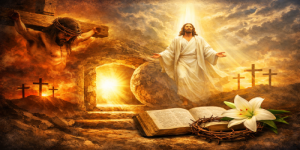


The Paschal Candle is first kindled during the Easter Vigil, a night that begins in darkness and culminates in the proclamation of the Resurrection. The candle’s flame, drawn from the “new fire,” is carried into the darkened church, a visible sign of Christ—the Light of the World—breaking the darkness of sin and death. As the Exsultet, the Easter Proclamation, rings out, the candle is enthroned in the sanctuary, where it will remain lit throughout the fifty days of Eastertide.
But the Paschal Candle is more than a ceremonial prop. It is a living symbol of the Risen Christ, present among His people. Its presence at Mass and at baptisms and funerals throughout the year reminds the faithful of Christ’s victory over death, and of the promise of eternal life.
The use of the Paschal Candle stretches back to the early centuries of Christianity. The candle was blessed at the start of the Easter Vigil and burned during all the liturgies of Eastertide. In the ancient Church, catechumens—those preparing to be baptized—received their baptism during this vigil. Afterward, they carried their own candles, lit from the Paschal Candle, into the assembly, representing the light of Christ now shining in their souls.
This act illustrates a theological truth: by baptism, Christians share in Christ’s death and resurrection, and are called to bear His light into the world. The Paschal Candle stands as a communal reminder of this individual calling.
For the forty days following Easter Sunday, the Paschal Candle stands in the sanctuary, its flame a sign that the Risen Christ is still with His followers. This period echoes the time that Jesus, after His Resurrection, appeared to the apostles and disciples, teaching them and preparing them for the coming of the Holy Spirit at Pentecost.
The candle’s steady presence reassures the faithful: Christ, the Bridegroom, has not left; He walks with His Church, offering peace, guidance, and hope.
The Feast of the Ascension, celebrated on the fortieth day after Easter, is pivotal. It marks the moment when Christ, having completed His work on earth, returns to the Father. The extinguishing of the Paschal Candle at the Ascension Mass is not just a liturgical footnote—it is the Church’s way of proclaiming that the period of the Risen Christ’s visible presence on earth has ended.
As the Gospel is read, recounting Jesus’ final instructions and His ascent into heaven, the candle is snuffed out. The sanctuary dims. This act is laden with meaning: just as Christ’s disciples watched Him depart, so too do we acknowledge His return to the Father.
There are legends that speak of early Christians lighting massive candles in hidden catacombs to celebrate the Resurrection. Some stories tell of the flame being passed secretly from house to house, a beacon of hope in times of persecution.
One anecdote from a medieval monastery describes a Paschal Candle so large it required a special pulley system to be raised and lowered during the long fifty days of Easter. When the time came for the Ascension, the entire community would gather, and as the candle was extinguished, a bell would toll—reminding all that Christ had “passed beyond the veil.”
The extinguishing of the Paschal Candle is not a sign of absence or abandonment. Rather, it reflects a shift. Christ is no longer present in the same way—He is now glorified, seated at the right hand of the Father. Yet, He remains with us, especially in the Sacraments, through the gift of the Holy Spirit, and in the living Church.
Venerable Fulton J. Sheen captured this mystery by describing Christ as “The Eternal Galilean”—present in every age, calling each person to follow Him, even if He is no longer seen as He was by the apostles.
After the Feast of the Ascension, the Paschal Candle is moved from the sanctuary and placed near the baptismal font. It is lit for baptisms, signifying that the newly baptized share in the life of the Risen Christ, and at funerals, offering hope that those who have died in Christ will rise with Him.
The extinguishing of the Paschal Candle serves as a call to spiritual readiness. Christ has gone to prepare a place for us; we, in turn, must prepare our hearts for Him. The flickering light may be gone, but the charge remains: to know, love, and follow Christ.
The simple act of extinguishing the Paschal Candle at the Ascension Mass is a profound, centuries-old symbol. It ties together the Resurrection, the presence of Christ, and the hope of eternal life. As the candle’s flame fades, the Church is not left in darkness; rather, she is called to bear the light of Christ into the world, empowered by the Holy Spirit, awaiting His promised return.